
Selected Publications
Full list of publications can be found:


Organic Electronics: charge transfer and charge transport


1. Zhang et al. Overcoming the fill-factor limit of organic solar cells. Nature Photonics, 2026, 19: 1-8.
2. Li et al. Recycling of spin-triplet excitons in organic photovoltaics. Nature, 2026, 652: 1204–1210.
3. Mahadevan et al. Assessing intra- and inter-molecular charge transfer excitations in non-fullerene acceptors using electroabsorption spectroscopy. Nature Communications, 2024, 15: 2393.
4. Liu et al. A generalized Stark effect electromodulation model for extracting excitonic properties in organic semiconductors. Nature Communications, 2019, 10: 5089.
5. Ma et al. Charge transfer-induced photoluminescence in ZnO nanoparticles. Nanoscale, 2019, 11(18): 8736–8743.
6. Li et al. On the study of exciton binding energy with direct charge generation in photovoltaic polymers. Advanced Electronic Materials, 2016, 2(11): 1600200.
7. Guan et al. Evidence of delocalization in charge-transfer state manifold for donor:acceptor organic photovoltaics. ACS Applied Materials & Interfaces, 2016, 8(33): 21798–21805.
8. Guan et al. Charge-transfer state energy and its relationship with open-circuit voltage in an organic photovoltaic device. The Journal of Physical Chemistry C, 2016, 120(26): 14059–14068.
9. Tsang et al. Charge-carrier induced barrier-height reduction at organic heterojunction. Physical Review B, 2008, 78(8): 081301(R).
10. Tsang et al. Application of admittance spectroscopy to evaluate carrier mobility in organic transport materials. Journal of Applied Physics, 2006, 99(1): 013701.
11. Chen et al. Dielectric effect on the photovoltage loss in organic photovoltaic cells. Advanced Materials, 2014, 26(35): 6125–6131.
12. Tsang et al. Energy level alignment and sub-bandgap charge generation in polymer:fullerene bulk heterojunction solar cells. Advanced Materials, 2013, 25(17): 2434–2439.
13. Small et al. High-efficiency inverted dithienogermole–thienopyrroledione-based polymer solar cells. Nature Photonics, 2012, 6: 115–120.
14. Tsang, S. W., Tao, Y., & Lu, Z. H. Temperature dependence of carrier injection across organic heterojunctions. Journal of Applied Physics, 2011, 109(2): 023711.
Perovskite: In-situ probing of crystallization and degradation


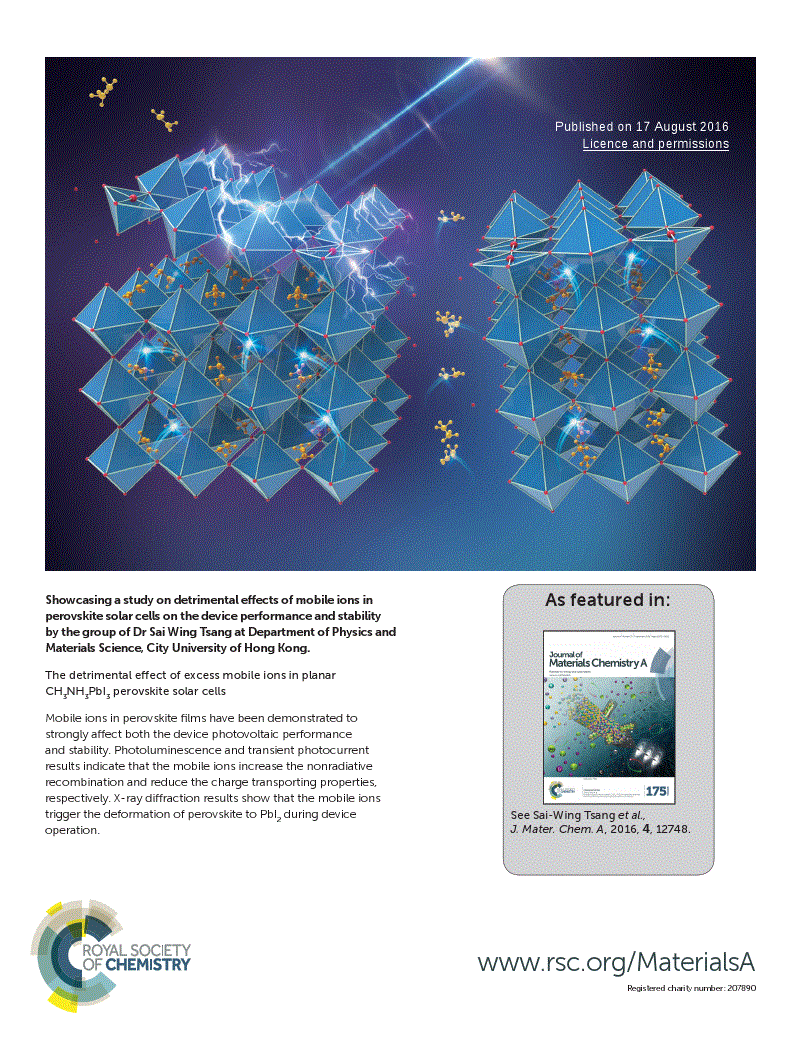
1. Wang et al. In situ optical techniques for perovskite crystallization. Joule, 2026, 10(8): 102545.
2. Wang et al. Beyond rapid nucleation: unveiling the role of solvent–precursor interactions in antisolvent-free perovskite fabrication. Energy & Environmental Science, 2026, 19(9): 2988–2998.
3. Wang et al. Intermediate state formation extends the ambient temperature processing window of solution-processed perovskite solar cells. ACS Energy Letters, 2025, 10(2): 647–657.
4. Wang et al. Unlocking the ambient temperature effect on FA-based perovskites crystallization by in situ optical method. Advanced Materials, 2024, 36(17): 2307635.
5. Zeng et al. Imbalanced surface charge induced phase segregation in mixed halide perovskites. Advanced Functional Materials, 2025, 35(21): 2404255.
6. Zeng et al. On the ion coordination and crystallization of metal halide perovskites by in situ dynamic optical probing. Small Methods, 2024, 8(1): 2300899.
7. Xie et al. FA-assistant iodide coordination in organic–inorganic wide-bandgap perovskite with mixed halides. Small, 2020, 16(10): 1907226.
8. Xie et al. Revealing the crystallization process and realizing uniform 1.8 eV MA-based wide-bandgap mixed-halide perovskites via solution engineering. Nano Research, 2019, 12: 1033–1039.
9. Cheng et al. Progress in air-processed perovskite solar cells: from crystallization to photovoltaic performance. Materials Horizons, 2019, 6(8): 1611–1624.
10. Li et al. Improving the conductivity of sol–gel derived NiOx with a mixed oxide composite to realize over 80% fill factor in inverted planar perovskite solar cells. Journal of Materials Chemistry A, 2019, 7(16): 9578–9586.
11. Xu et al. Air-processed mixed-cation Cs0.15FA0.85PbI3 planar perovskite solar cells derived from a PbI2–CsI–FAI intermediate complex. Journal of Materials Chemistry A, 2018, 6(17): 7731–7740.
12. Cheng et al. Decomposition of organometal halide perovskite films on zinc oxide nanoparticles. ACS Applied Materials & Interfaces, 2015, 7(36): 19986–19993.